
Translation Requirements: Australia vs Canada vs UK (2026 Comparison Guide)
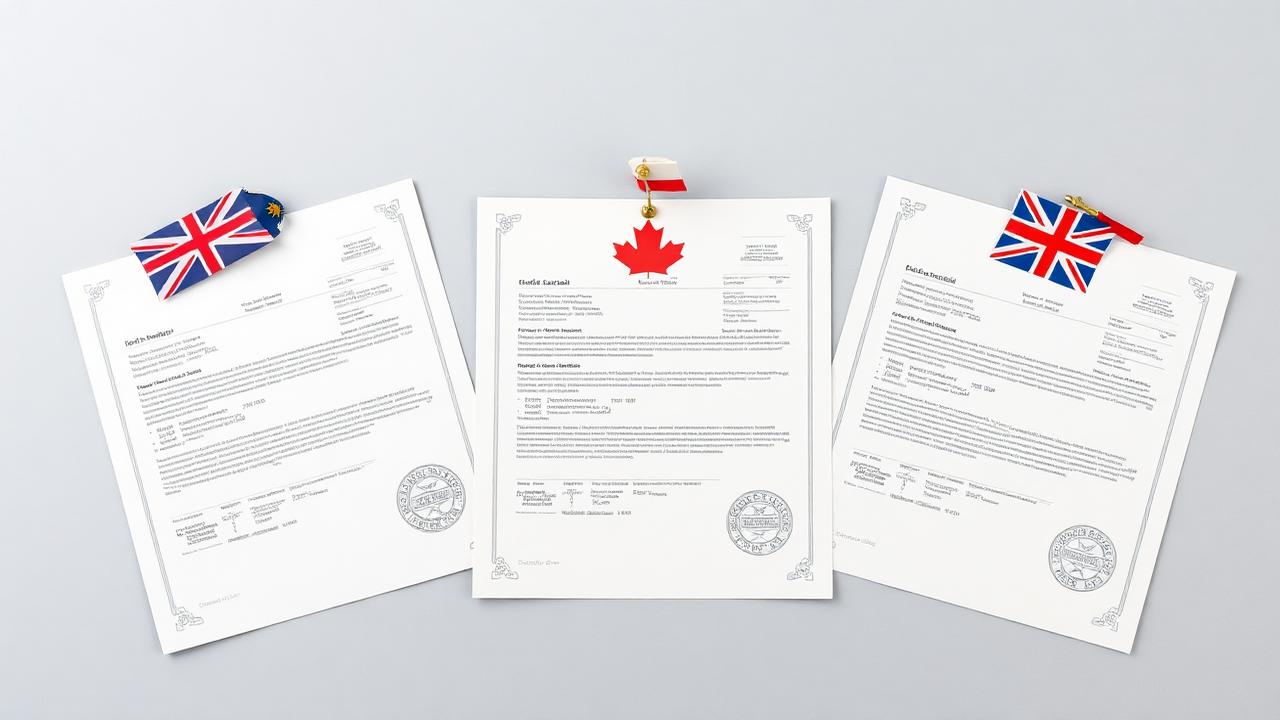
An applicant in Melbourne planning a partner visa for Australia, a study permit for Canada, and a Skilled Worker route for the United Kingdom rarely needs three separate translation packs. She needs one carefully ordered set of certified files that each country will accept on first read. The decision tree behind that pack is the part most guides skip, because each country writes its own rulebook in its own language and the rules sit on different government websites. This article puts the three regimes on one page so you can plan the work in a single sitting.
The three regimes at a glance
Australia, Canada, and the United Kingdom all require a certified translation for any document not originally produced in English or, for parts of Canada, French. The credential they trust is where the regimes diverge. Australia routes everything through one national authority. Canada hands the standard to provincial regulatory bodies. The United Kingdom does not run a state register at all and relies on a translator company self certification model.
| Requirement | Australia | Canada | United Kingdom |
|---|---|---|---|
| Governing authority | NAATI (national) | Provincial regulatory bodies, mainly ATIO, OTTIAQ, STIBC | No state body; ITI and CIOL membership commonly accepted |
| Translator standard | NAATI certified practitioner | Certified translator under provincial body, or affidavit through notary if uncertified | Professional translator or registered agency with certification statement on letterhead |
| Certification format | NAATI stamp or verified digital seal with practitioner ID | Member seal plus declaration; or notarised affidavit | Signed statement of accuracy, date, translator credentials, and contact details |
| French acceptance | English only target | English or French target accepted nationally | English only target |
| Public verification path | Open NAATI online directory | Each provincial body publishes its own register | No central register; verify through ITI or CIOL directory if applicable |
Read across one row and you can see why a single translation rarely travels intact. A NAATI translation lodges cleanly in Australia and is also a strong reference document elsewhere, but Canada and the United Kingdom each want a certification statement framed for their own administrative culture. Plan around that from the start and you avoid paying twice for the same source document.
Australia: one authority, one verification path
The Australian rule is the cleanest of the three. The Department of Home Affairs prefers translations certified by a NAATI practitioner, and most agencies treat NAATI as the operational standard for any document going to a federal authority. The credential is searchable by practitioner ID at naati.com.au, which lets a case officer verify the translator in seconds without leaving the directory. That single shortcut explains why most successful files are commissioned through established certified translation services australia rather than overseas providers whose credentials need to be checked through several layers of correspondence.
Australia also runs the strictest position on AI assisted output. A translation must carry a credentialed human signature, a practitioner identifier, and a certification block that mirrors the original layout. Files that miss any of those elements fail the first structural pass a case officer runs.
Canada: a provincial map with a federal overlay
Canada is the one country of the three where the rules shift depending on where the certified translator practises. Immigration, Refugees and Citizenship Canada accepts translations produced anywhere in Canada by a member in good standing of a provincial regulatory body. The most commonly cited bodies are the Association of Translators and Interpreters of Ontario, the Ordre des traducteurs, terminologues et interprètes agréés du Québec, and the Society of Translators and Interpreters of British Columbia. Where a certified member is not available, the federal guidance accepts a translation by any competent translator accompanied by a sworn affidavit witnessed by a notary public. The full federal note sits on the Government of Canada immigration page and is the authority every IRCC officer applies.
Two practical features set Canada apart. Either English or French is accepted as the target language across the entire federation, which can save money for Australian applicants whose source documents are already in French. The notary route is also a real safety net for rarer language pairs where a provincially certified translator may not exist locally.
United Kingdom: company certification, no state register
The United Kingdom does not maintain a national translator register and does not require a state credentialed translator. Home Office guidance asks for a translation that includes a signed statement of accuracy, the translator or agency contact details, the translation date, and confirmation that the document is a true translation of the original. Membership of the Institute of Translation and Interpreting or the Chartered Institute of Linguists is widely accepted as evidence of professional standing and is the de facto standard most universities and the Home Office expect to see. The published policy is in the UK Visas and Immigration guidance on gov.uk.
The looser framework comes with a different kind of risk. With no central register, applicants take on more verification work themselves and refusals based on translator credentials are harder to predict in advance.
Cost and turnaround across the three regimes
Pricing varies by language pair, document length, and provider, so the figures below are typical ranges in Australian dollars for a single page certified translation of an identity document such as a birth certificate.
| Country | Typical cost (AUD) | Standard turnaround | Notes |
|---|---|---|---|
| Australia | $44.95 to $79.95 | From 1 hour for self serve extracts; 2 to 3 business days for full translations | No guaranteed turnaround; standard times only. |
| Canada | AUD equivalent of about CAD 60 to 120 | 2 to 5 business days, longer if notary affidavit is required | Notary fee is separate when using the affidavit route. |
| United Kingdom | AUD equivalent of about GBP 50 to 90 | 2 to 4 business days for routine certified translations | Cost rises sharply for sworn or notarised versions. |
The Australian figures reflect the published Passport Translations price list and are an exact match for current rates. Canadian and United Kingdom figures are typical market ranges and should be confirmed with the provider you choose.
Cross acceptance: which translation travels and which does not
The most common question from clients planning parallel applications is whether one translation can serve two countries. The honest answer is that a NAATI translation is the most portable starting point of the three because it carries a verifiable practitioner ID, a certification statement that mirrors international expectations, and a layout that matches the original document. It is the same logic that drives the documentation choices in our comparison of Australian and European translation rules, where a single national register consistently outperforms a fragmented one for cross border use.
| Starting translation | Accepted in Australia | Accepted in Canada | Accepted in United Kingdom |
|---|---|---|---|
| NAATI certified (Australia) | Yes, standard | Often, with a covering affidavit if challenged | Often, when accompanied by ITI or CIOL endorsement |
| ATIO or OTTIAQ certified (Canada) | Sometimes, but NAATI usually requested | Yes, standard | Often accepted on a case by case basis |
| UK company certified | Rarely accepted without NAATI verification | Rarely accepted without a Canadian affidavit | Yes, standard |
If your priority lodgement is Australia, commission the NAATI translation first and treat it as the master file. Identity documents such as birth certificate translations usually carry across borders well when the source scan is high resolution and the certification page is left intact.
A practical decision matrix for parallel applications
Three short questions resolve most parallel application scenarios.
First, which country receives the first lodgement. Order the work to that authority and use its credential as the anchor. Second, are any of the destination countries French speaking for administrative purposes. If yes, factor in a French target for Canadian use and an English target for Australia and the United Kingdom. Third, do any documents already exist in English or French. Skip the unnecessary translation, but order a clean recertified copy for the destination that wants its own certification statement on the file.
Common mistakes when juggling three regimes
The most expensive mistake is treating any one translation as universally valid. The second is leaving recertification deadlines off the planning calendar, since Canada and the United Kingdom are stricter about freshness for sworn or notarised documents than Australia is. The third is downloading a free template for a certification statement and pasting it into a translation produced by an uncredentialed translator. None of the three regimes accept that approach, and recovering from it costs more than commissioning the right translation in the first place.
The bottom line for Australian applicants planning parallel moves
Australia, Canada, and the United Kingdom apply three genuinely different translation regimes. Build the document set around the country with the strictest verification standard, which in almost every case is Australia, and the other two regimes can usually be satisfied with targeted additions rather than rework. That is the closest thing to a single translation strategy that works across all three borders.
About the author. Anya Petrov is a Cross Border Documentation Consultant with nine years of experience advising Australian clients planning parallel migration, study, and work moves across Australia, Canada, and the United Kingdom.