
Nepali to English NAATI Translations – Key Information for New Migrants
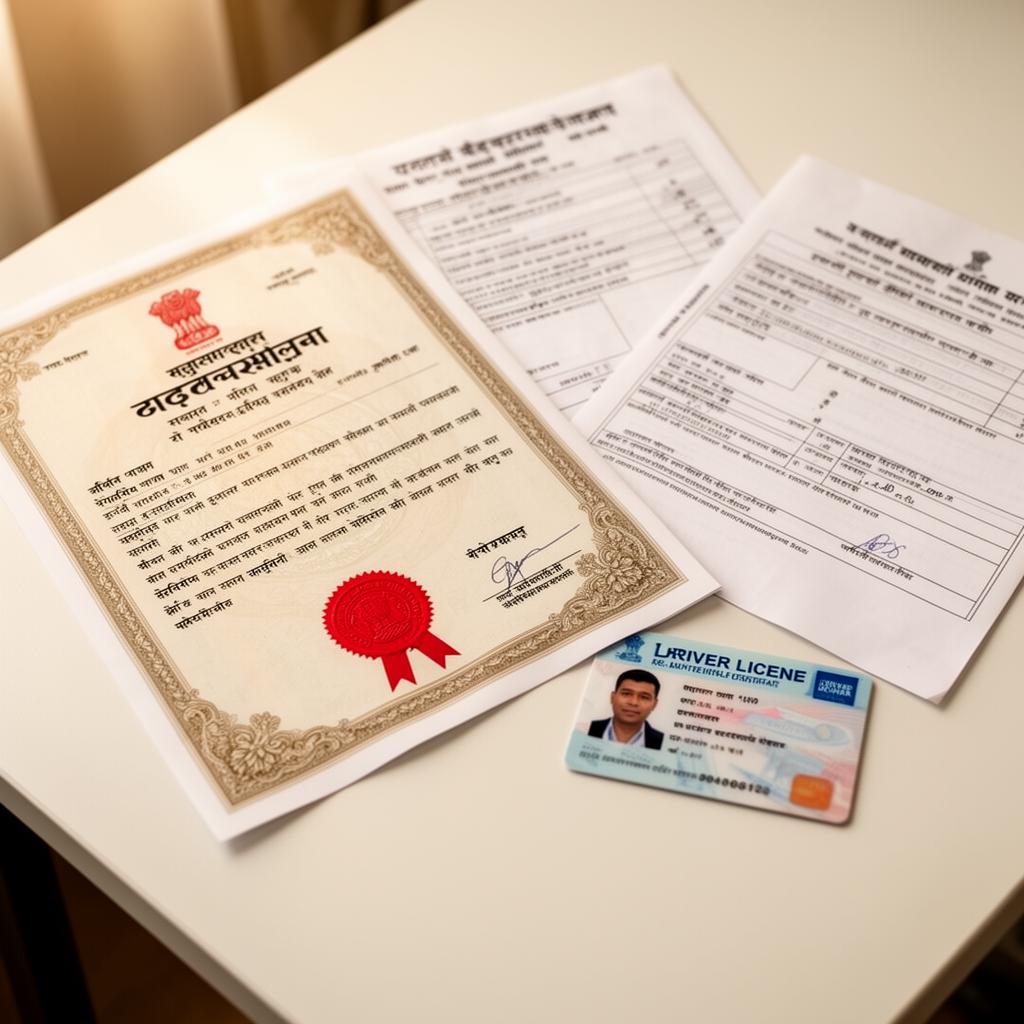
Nepal's administrative system produces documents that are distinctly different from those encountered in most other countries — from the nagarikta (नागरिकता) citizenship certificate that serves as the primary identity document, to academic records issued under Nepal's SLC and SEE examination systems. For Nepali nationals applying for Australian visas, understanding which documents require NAATI approved translators and how each document functions within Nepal's bureaucratic framework is essential.
The Department of Home Affairs requires all non-English documents to be accompanied by certified translations completed by a NAATI accredited translator. Nepali documents present specific challenges: Devanagari script (देवनागरी) that must be transliterated accurately, the Bikram Sambat (B.S.) calendar system used on most official documents, and document formats that vary between District Administration Offices across Nepal's 77 districts.
This guide explains every major Nepali document type you may need translated, the specific challenges each presents, and how to ensure your translations meet Australian immigration standards. Whether you're applying for a skilled migration visa, partner visa, student visa, or converting your Nepali driver licence through VicRoads, Service NSW, or another state authority, these requirements apply across all contexts.
Why Nepali Documents Require Specialist Translation
Nepali (नेपाली) is written in Devanagari script — the same script used for Hindi and Sanskrit, but with distinct vocabulary, administrative terminology, and document conventions. A NAATI certified Nepali translator must not only read Devanagari fluently but also understand Nepal's unique governmental and civil registration systems.
Nepal's civil registration is administered through District Administration Offices (जिल्ला प्रशासन कार्यालय) and local Ward Offices (वडा कार्यालय). Document formats have changed significantly over the decades — older documents from the Panchayat era look entirely different from those issued after Nepal became a federal republic in 2008. The translator must be familiar with both historical and current formats.
The Department of Home Affairs expects translations to faithfully reproduce every element of the original document, including all stamps, seals, and handwritten annotations. Information about document requirements is available through the Department of Home Affairs document requirements page.
Citizenship Certificate (नागरिकता प्रमाणपत्र – Nagarikta)
The Nepali citizenship certificate — nagarikta pramanpatra (नागरिकता प्रमाणपत्र) — is arguably the most important identity document in Nepal. Unlike Australia, where birth certificates and passports serve as primary identity documents, the nagarikta is the foundation for nearly all official dealings in Nepal, from opening a bank account to obtaining a passport.
A typical nagarikta contains:
- Full name (पूरा नाम) in Devanagari
- Date of birth (जन्म मिति) — in Bikram Sambat
- Permanent address (स्थायी ठेगाना)
- Father's and mother's names
- Citizenship number and type (by descent, by birth, or naturalised)
- Photograph and fingerprint
- Official stamp of the Chief District Officer (प्रमुख जिल्ला अधिकारी)
Example: A nagarikta issued by the District Administration Office of Kathmandu (जिल्ला प्रशासन कार्यालय, काठमाडौं) will bear the official seal and signature of the Chief District Officer.
Translation challenge: Older nagarikta certificates (pre-2007) were issued under the Kingdom of Nepal and reference the monarch. Post-2007 certificates reference the Federal Democratic Republic of Nepal. The translator must accurately reflect the governmental designation that appears on the original document, not update it to the current system.
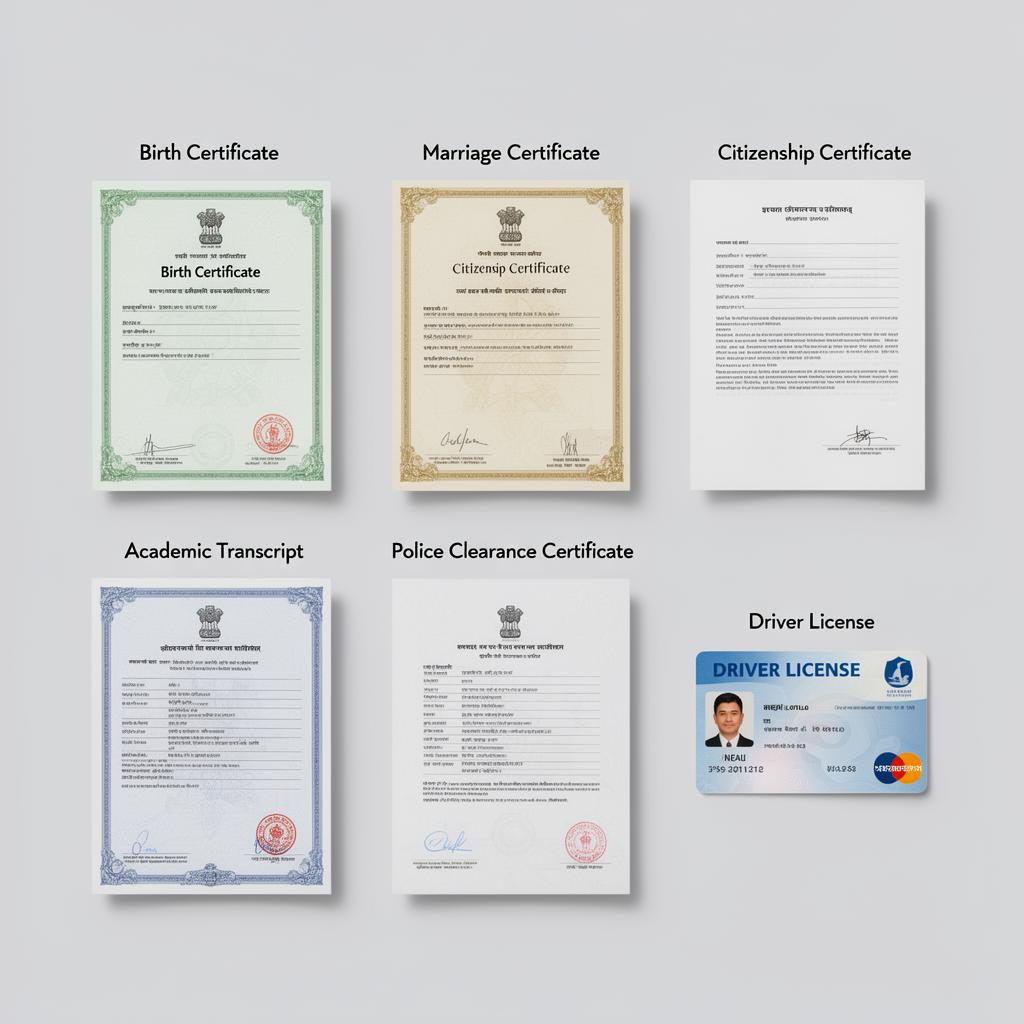
Birth Certificates (जन्मदर्ता प्रमाणपत्र)
The Nepali birth certificate — janma darta pramanpatra (जन्मदर्ता प्रमाणपत्र) — is issued by the local Ward Office (वडा कार्यालय) or Village Development Committee (गाउँ विकास समिति). Birth registration became mandatory in Nepal under the Birth, Death and Other Personal Events Registration Act, but registration rates have historically been lower in rural areas.
A Nepali birth certificate typically contains:
- Child's full name (बच्चाको नाम)
- Date of birth (जन्म मिति) — in Bikram Sambat
- Place of birth (जन्म स्थान)
- Gender (लिङ्ग)
- Father's and mother's names
- Registration number and date
- Official stamp and signature of the local registrar
Important note: Many Nepali nationals born before 2000, particularly in rural areas, may not have a birth certificate. In such cases, the nagarikta often serves as the primary proof of identity and date of birth for immigration purposes. The translator should note this context when relevant.
For more information about birth certificate translation, visit our birth certificate translation service page.
Marriage Certificates (विवाह दर्ता प्रमाणपत्र)
The Nepali marriage certificate — vivaha darta pramanpatra (विवाह दर्ता प्रमाणपत्र) — is issued by the local Ward Office upon registration of a marriage. This document is essential for partner visa applications (subclasses 309/100 and 820/801).
A Nepali marriage certificate typically includes:
- Full names of both spouses (in Devanagari)
- Dates of birth
- Date and place of marriage registration
- Registration number
- Witnesses' details
- Official stamp of the Ward Office or Village Development Committee
Cultural context: In Nepal, many marriages are conducted through traditional or religious ceremonies before being formally registered. The date on the marriage certificate may differ from the actual ceremony date. Australian immigration authorities rely on the registered date, so the translation must clearly reflect what appears on the official document.
Police Clearance Certificate (चारित्रिक प्रमाणपत्र)
The Nepali police clearance certificate — chaaritrink pramanpatra (चारित्रिक प्रमाणपत्र) — is issued by the Nepal Police Headquarters (नेपाल प्रहरी प्रधान कार्यालय, नक्साल) in Kathmandu. This document is required for character assessment if you have lived in Nepal for 12 months or more in the past 10 years.
The police clearance certificate states whether the individual has any criminal record in Nepal. It typically includes:
- Full name and address of the applicant
- Citizenship number
- Purpose of the clearance
- Statement of criminal record status
- Official stamp and signature of the issuing police authority
Validity: Nepali police clearance certificates are generally valid for 6 months from the date of issue. Plan your translation timeline to ensure the certificate remains valid when your visa application is assessed.
Further details about police clearance translation are available on our police clearance translation service page.
Education Documents (शैक्षिक प्रमाणपत्र र अंकपत्र)
Nepal's education system produces several types of documents that are frequently required for skilled migration visas, student visas, and professional skills assessments:
- SLC/SEE Certificate: The School Leaving Certificate (SLC) — previously known as the "Iron Gate" exam — was replaced by the Secondary Education Examination (SEE) in 2016. Both certificates are issued by the National Examination Board (राष्ट्रिय परीक्षा बोर्ड). Older applicants will have SLC certificates; newer graduates will have SEE certificates
- Higher Secondary (+2) Transcripts: Issued by the Higher Secondary Education Board (HSEB) or its successor, the National Examination Board. These cover grades 11 and 12
- University Degrees: Tribhuvan University (TU), Kathmandu University (KU), Pokhara University (PU), and other institutions issue degree certificates (उपाधि प्रमाणपत्र) and transcripts (अंकपत्र)
- Character Certificates from Schools: Often required alongside academic transcripts, these are issued by the school or college
Grading system: Nepal uses a percentage-based grading system. The SLC traditionally used divisions: First Division (60%+), Second Division (45–59%), Third Division (32–44%). The newer SEE uses a GPA-based system (0.8–4.0). The translator must reproduce the grading system exactly as it appears on the original document.
For skills assessments through bodies like VETASSESS or Engineers Australia, academic transcripts must be translated in full — including all subject names, grades, and institutional details. Partial translations are not accepted.
Driver Licence (सवारी चालक अनुमतिपत्र)
The Nepali driver licence — sawari chalak anumatipatra (सवारी चालक अनुमतिपत्र) — is issued by the Department of Transport Management (यातायात व्यवस्था विभाग) under the Ministry of Physical Infrastructure and Transport. Nepali nationals moving to Australia frequently need their licence translated for conversion through state road authorities such as VicRoads, Service NSW, or the Department of Transport and Main Roads (Queensland).
Nepali driver licence categories include:
- A: Motorcycle
- B: Car / Jeep / Van (up to 9 seats)
- C: Tempo / Auto-rickshaw
- D: Minibus / Truck
- E: Bus
- F, G, H, I, J, K: Heavy vehicles, cranes, dozers, and other specialised categories
Example: A licence showing "श्रेणी B" (Category B) issued in Kathmandu with an expiry date in 2082 B.S. (approximately 2025/2026 A.D.) would need all fields translated, including the licence number, category, issuing authority, validity period, and the Bikram Sambat dates converted with a note explaining the calendar system.
Learn more about our driver licence translation services.
The Bikram Sambat Calendar System
One of the most distinctive aspects of Nepali documents is the use of the Bikram Sambat (B.S.) calendar — also called Vikram Samvat. This is a lunisolar calendar that is approximately 56 years and 8–9 months ahead of the Gregorian (A.D.) calendar. Nepal is one of the few countries in the world that uses B.S. as its official calendar.
Conversion examples:
- 1 Baisakh 2081 B.S. = 13 April 2024 A.D.
- 15 Mangsir 2075 B.S. = 1 December 2018 A.D.
- 1 Shrawan 2060 B.S. = 17 July 2003 A.D.
A certified translator must accurately convert B.S. dates to their Gregorian equivalents and note in the translation that the original document uses the Bikram Sambat calendar. Incorrect date conversions can cause significant issues with visa processing, as case officers may interpret dates incorrectly.
Other Important Nepali Documents
Beyond the core documents above, several other Nepali documents may be required depending on your visa subclass:
- National ID Card (राष्ट्रिय परिचयपत्र): Nepal has been rolling out biometric national identity cards since 2011. While not yet universally held, these cards may appear alongside the nagarikta as supporting identity evidence
- Relationship Certificates (नाता प्रमाणित): Issued by Ward Offices to certify family relationships — commonly used for parent visa and dependent visa applications. These confirm the relationship between individuals (e.g., parent-child, sibling)
- Land Ownership Certificates (लालपुर्जा): The lalpurja is the land ownership certificate issued by the Department of Land Management. These may be required for financial evidence in certain visa subclasses
- Death Certificates (मृत्यु दर्ता प्रमाणपत्र): Issued by local Ward Offices and required if a previous spouse is deceased or for certain family visa applications
Common Problems with Nepali Document Translation
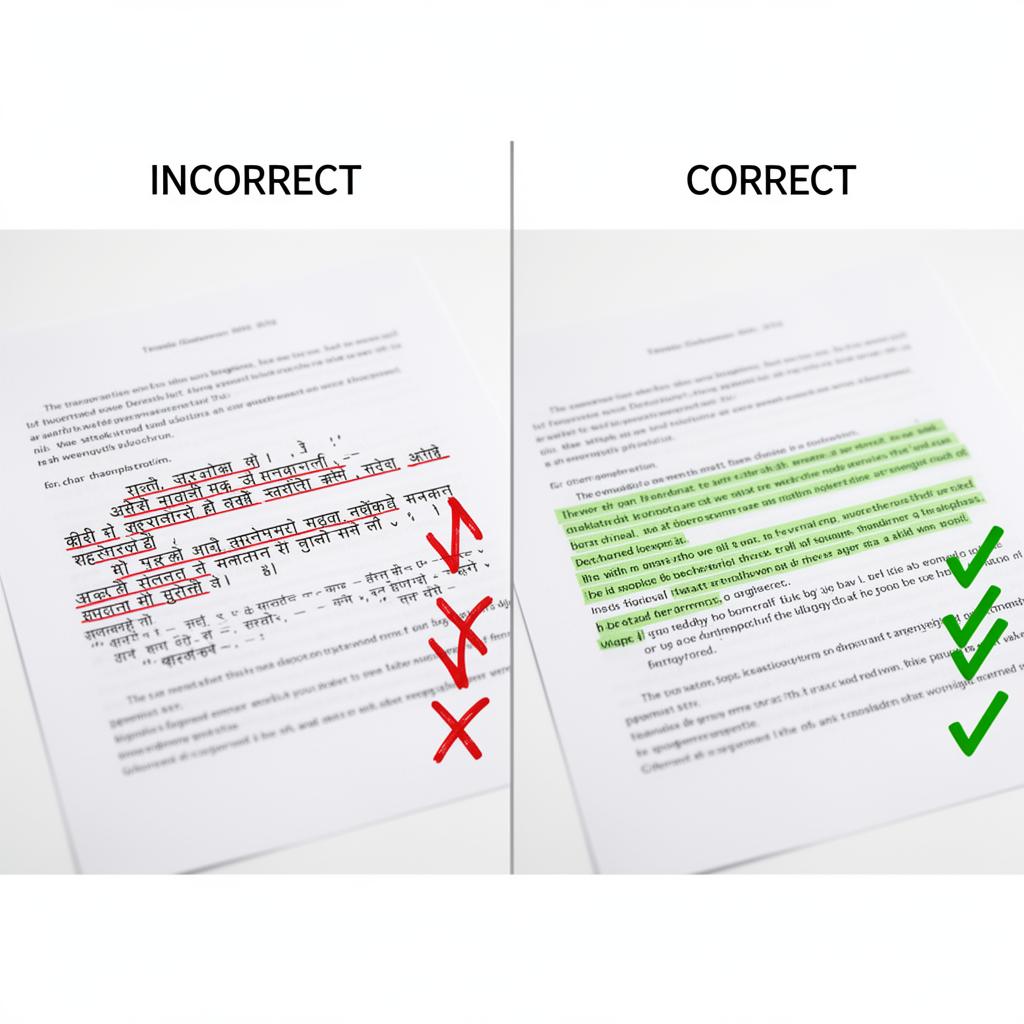
Nepali documents present specific translation challenges that less experienced translators frequently get wrong:
- Incorrect date conversion: The Bikram Sambat to Gregorian conversion is the single most common error in Nepali document translation. A translator who uses rough approximations (simply subtracting 57 years) rather than precise conversion tables will produce incorrect dates. Even a one-day error can cause problems if it leads to a date mismatch with other documents
- Devanagari transliteration errors: Nepali Devanagari includes conjunct consonants (संयुक्त व्यञ्जन) and vowel marks that can be misread. For example, "श्रेष्ठ" (Shrestha) could be incorrectly transliterated as "Shresth" or "Srestha" — both of which would cause name mismatch issues
- Inconsistent name romanisation: Nepali names are romanised inconsistently even on official documents. "ज्ञवाली" could appear as "Gyawali", "Gnawali", or "Gyanwali" on different documents. The translator must reproduce the spelling as it appears on each specific document, noting any inconsistencies
- Unclear scans of handwritten documents: Many Nepali official documents, especially older ones, contain handwritten entries in Devanagari. Poor-quality scans can make individual characters indistinguishable, and the translator must note any illegible portions
- Missing stamps and seals: Nepali government documents typically bear multiple stamps — an official seal, a revenue stamp (टिकट), and sometimes a verification stamp. If any stamps are missing or unclear in the scan, the translator should note this rather than omitting the information
Australia vs New Zealand: Nepali Document Requirements
| Requirement | Australia | New Zealand |
|---|---|---|
| Online Portal | ImmiAccount | Immigration NZ Online |
| NAATI Required | Preferred / Standard | Not mandatory |
| Calendar Conversion | Must include A.D. equivalents | A.D. equivalents recommended |
| Digital ID Verification | Common via NAATI directory | Less common |
| Nagarikta Accepted | Yes, as identity evidence | Yes, with translation |
Information about New Zealand immigration requirements is available through Immigration New Zealand.
How to Get Your Nepali Documents Translated
The process for getting Nepali documents translated for Australian immigration is straightforward:
- Scan your original Nepali document clearly — ensure all Devanagari text, stamps, and signatures are visible
- Upload your document through our secure platform
- A NAATI certified Nepali-English translator completes the translation
- The translation includes the translator's NAATI practitioner ID and certification statement
- You receive the completed translation as a PDF, ready for submission to the Department of Home Affairs or any Australian authority
All translations are completed by translators listed on the NAATI online directory, ensuring they meet the standard expected by Australian authorities.
Cost of Nepali Document Translation
Translation costs depend on the document type and complexity:
| Service Type | Price (AUD) | Best For |
|---|---|---|
| Self-Serve Extract Translation | $44.95 | Standard certificates with familiar formats |
| Extract Translation | $59.95 | Nagarikta, birth certificates, marriage certificates |
| Full Translation | $79.95 | Academic transcripts, multi-page documents |
Factors that affect pricing include:
- Document length and complexity
- Handwritten vs printed Devanagari content
- Legibility of the original document
- Number of pages (particularly relevant for academic transcripts and relationship certificates)
Standard turnaround times are: self-serve extract translations from 1 hour, extract translations from 1 business day, and full translations from 2–3 business days.
Frequently Asked Questions
Do Nepali documents need to be translated for Australian visa applications?
Yes. The Department of Home Affairs requires all non-English documents to be accompanied by a certified English translation completed by a NAATI accredited translator. This applies to all Nepali documents submitted with your visa application, including the nagarikta, birth certificates, and academic records.
What is a nagarikta and why is it important?
The nagarikta (नागरिकता प्रमाणपत्र) is Nepal's citizenship certificate — the primary identity document for all Nepali citizens. It serves a similar function to a birth certificate and national ID combined. For Australian immigration, the nagarikta is commonly submitted as proof of identity and nationality.
How are Bikram Sambat dates converted in translations?
A NAATI certified translator uses verified conversion tools to accurately convert Bikram Sambat (B.S.) dates to their Gregorian (A.D.) equivalents. The translation will include both the original B.S. date and the converted A.D. date, with a note explaining the calendar system used in Nepal.
Can I use my nagarikta instead of a birth certificate?
In many cases, yes. Many Nepali nationals, particularly those born before systematic birth registration, use the nagarikta as their primary proof of identity and date of birth. The Department of Home Affairs generally accepts the nagarikta as identity evidence, but requirements may vary by visa subclass.
What if my name is spelt differently across my Nepali documents?
Inconsistent romanisation of Nepali names is common. The translator will translate each document as it appears, reproducing the exact spelling shown. If discrepancies exist between documents, you may need to provide a statutory declaration explaining the variations.
How much does Nepali document translation cost?
Prices start from $44.95 for self-serve extract translations, $59.95 for extract translations, and $79.95 for full translations. The cost depends on the document type, length, and complexity.
Is NAATI accreditation mandatory for Nepali translations?
The Department of Home Affairs strongly prefers translations completed by NAATI accredited translators. While overseas certified translators may occasionally be accepted, NAATI certification reduces verification issues and is the standard expected by Australian authorities.
Key Takeaways
- Nepali documents use Devanagari script and the Bikram Sambat calendar — both require specialist translation knowledge
- The nagarikta (citizenship certificate) is Nepal's primary identity document and is commonly required for Australian visa applications
- Accurate B.S. to A.D. date conversion is critical — approximate conversions can cause visa processing delays
- Name romanisation inconsistencies are common across Nepali documents and should be noted by the translator
- Always use a NAATI accredited translator experienced with Nepali documents
- Prices start from $44.95 for standard certificates
Conclusion
Translating Nepali documents for Australian immigration requires more than basic language skills — it demands familiarity with Nepal's unique administrative systems, the Bikram Sambat calendar, Devanagari script conventions, and the specific formats used by District Administration Offices and Ward Offices across Nepal's districts.
Whether you need your nagarikta translated for a skilled migration visa, your academic transcripts assessed for a skills assessment, or your driver licence converted for use in Australia, choosing a NAATI certified translator with Nepali expertise ensures your documents meet the standards expected by the Department of Home Affairs and other Australian authorities.
For certified Nepali to English translation services, our team of NAATI accredited translators is ready to assist with all your document translation needs.
This article was prepared by a NAATI-certified translator working with our team, based on experience handling certified translations for official use in Australia.